When Is a Software Prototype a Waste of Time for a Startup?
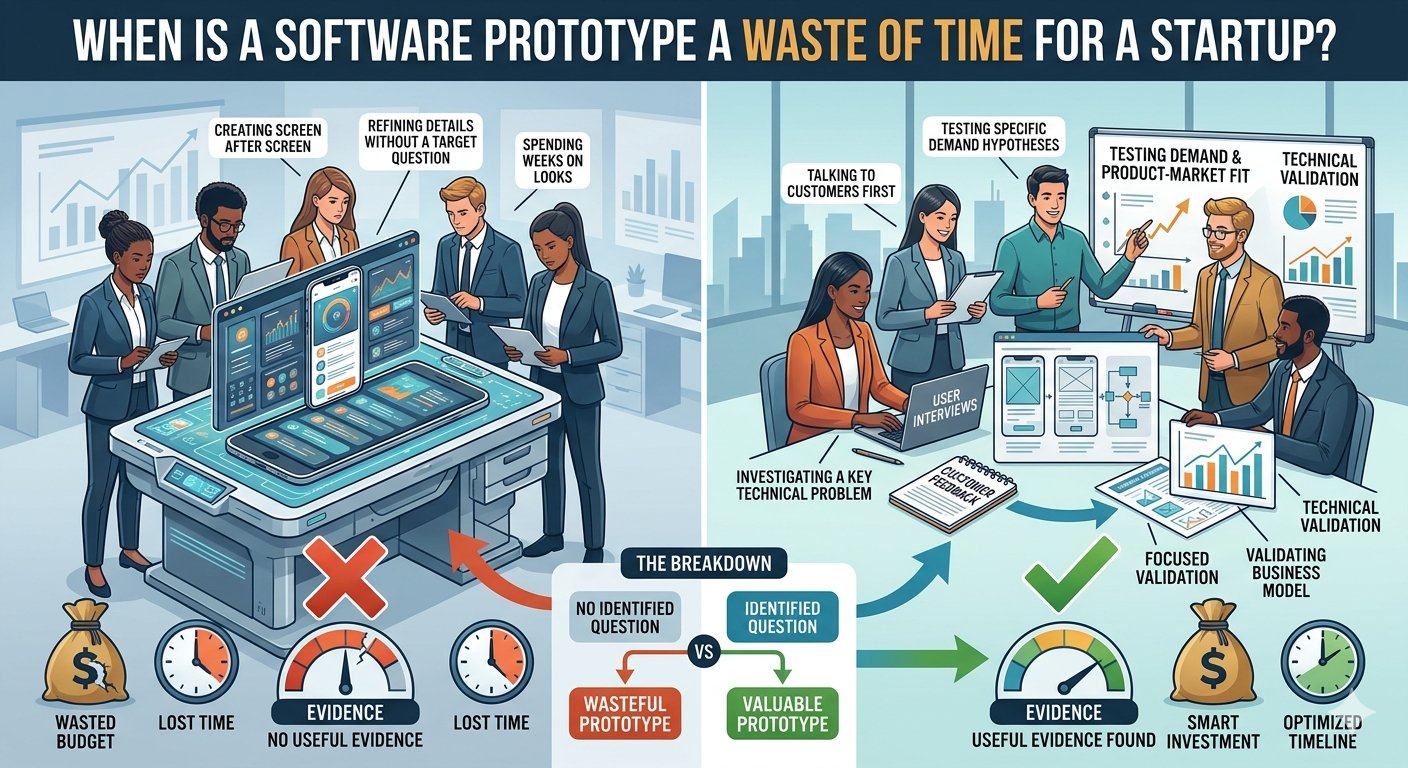
A software prototype is often treated as the safest first step for a startup. Instead of spending heavily on the full product, the team creates a smaller version, shows it to users, collects feedback, and uses what it learns to guide development.
That approach can work very well. But there is a problem with treating prototyping as an automatic step in every startup journey: a prototype only has value when it helps answer an important question.
If the startup has not identified the question, the prototype can become an expensive way of creating something that looks like progress without producing useful evidence. A team may spend weeks refining screens when it really needs to talk to customers, test demand, investigate a technical problem, or validate its business model.
The better question is therefore not, “Should every startup build a prototype?” It is, “What uncertainty will this prototype remove?”
If the answer is unclear, building one may be a waste of time.
Start by Asking What the Prototype Is Supposed to Prove
Before opening Figma, choosing a technology, or hiring a prototype development team, define the decision the prototype is supposed to support.
A startup usually has several uncertainties at the beginning. It may not know whether customers actually have the problem, whether they will pay for a solution, whether the proposed workflow makes sense, whether a particular technology can support the idea, or whether users can understand the product.
These are different problems. They should not all be tested with the same type of prototype.
For example, imagine a startup wants to build an application that helps small retailers automatically manage their inventory. The founder may believe retailers have a serious inventory problem, but that belief has not been tested. Building ten polished screens showing inventory dashboards, alerts, reports, and supplier management does not prove that retailers want the product.
Customer interviews and a simple demand experiment may provide more useful information. On the other hand, suppose the problem has already been validated and the startup is unsure whether users will understand a complicated inventory workflow. In that case, an interactive prototype could be exactly what is needed.
This distinction is important when working with a prototype development company for startups as well. The team should know what the prototype is intended to validate before deciding how much should be built.
A useful way to think about the decision is:
Problem uncertainty → Research
Demand uncertainty → Experiment
User experience uncertainty → Prototype
Technical uncertainty → Proof of concept
Business-model uncertainty → Pilot
Validated product idea → MVP
The prototype should therefore have a job. If that job cannot be described in a sentence, the startup may be building too early.
This is also where Triple Minds can be relevant for startups that need to decide whether they actually need a prototype, rather than simply assuming that prototyping is the next stage of development. The important thing is to connect the development activity to a specific business question.
When You Haven’t Validated the Problem Yet
One of the biggest reasons a prototype becomes unnecessary is that the startup is trying to design a solution before proving that the problem deserves a solution.
This happens frequently because software is easier to visualize than an unresolved business problem. A founder can quickly imagine a dashboard, mobile application, marketplace, AI assistant, or booking system. Once those screens exist, the idea feels more real.
But visualizing a solution does not validate the problem. Suppose someone wants to create an application for independent fitness coaches because they believe coaches struggle with managing client schedules. The founder could spend weeks designing calendars, reminders, payment screens, client profiles, workout plans, and analytics.
Then the team may discover that scheduling was never the major problem. Coaches may already use Google Calendar successfully. Their real difficulty might be getting new clients, following up with leads, or keeping customers engaged.
The prototype did not solve the uncertainty. It simply made the original assumption more detailed. In this situation, customer conversations can be more valuable than software. Talking to potential users, observing their existing workflow, reviewing how they solve the problem today, and identifying what they already pay for can reveal whether there is a meaningful opportunity.
This does not mean prototypes have no role in problem validation. They can be useful when users need to react to a concrete experience rather than describe an abstract idea. The problem occurs when the prototype becomes the first source of learning instead of one tool within a broader validation process.
There is another subtle danger here. Once a startup has invested money and time into a polished prototype, the team can become emotionally attached to the solution. Negative customer feedback becomes harder to accept because changing the idea now means changing something that has already been built. Starting with problem research keeps the cost of being wrong much lower. A prototype is most useful when the startup already understands the problem well enough to ask a narrower question about the proposed solution.
When You Can Test the Idea Without Building a Prototype
Not every product idea requires software to be tested.
This is one of the most overlooked reasons to avoid prototyping too early. Founders sometimes assume that the only way to test a digital product is to build a smaller digital product.
Often, it is not. Consider a startup planning a marketplace that connects businesses with specialized consultants. Before building profiles, search filters, messaging, payments, reviews, dashboards, and matching algorithms, the founders could manually connect a small number of businesses with consultants. If customers are willing to use the service and pay for it, the startup has learned something important without building the marketplace.
The same principle can be applied to many software ideas. A landing page can test whether people respond to a specific value proposition. A form can collect requests before an application exists. A spreadsheet can simulate an internal workflow. A concierge service can manually perform tasks that the eventual software will automate. A no-code tool can test a basic process. Existing platforms can sometimes be combined to create a temporary version of the experience.
These approaches are not always replacements for prototypes. Their value is that they can answer earlier and cheaper questions. Imagine a founder wants to build an AI-powered social media management platform for small businesses. The planned product may include automated content creation, scheduling, analytics, approval workflows, customer-specific AI agents, and integrations with several social networks.
Before designing the complete interface, the founder could manually create content for ten businesses and manage the publishing workflow using existing tools.
If customers do not value the service, a polished prototype would not have solved the fundamental problem. If customers love the service but repeatedly struggle with reviewing AI-generated content, then the startup has discovered a much more useful design question. That is the point where prototyping becomes valuable because there is now a specific user experience to investigate.
The principle is simple: use the cheapest reliable experiment that can answer the question you have.
A prototype can be the right experiment, but it should not become a default expense simply because the final product will eventually be software. This is especially relevant for startups with limited budgets. Every dollar spent on unnecessary interface work is money that cannot be spent on customer research, technical validation, acquisition experiments, or building the actual product. The goal is not to avoid building software. The goal is to avoid building the wrong thing too early.
When the Real Question Is Technical Feasibility
A prototype can show how a product is expected to look and behave, but that does not necessarily prove that the product can be built as imagined.
This distinction matters when the biggest risk in a startup idea is technical rather than visual.
Suppose a startup wants to build an application that processes large amounts of real-time data, uses computer vision to identify objects, connects to several third-party systems, or depends on a complex AI workflow. A polished clickable prototype may demonstrate the user journey perfectly while saying almost nothing about whether the underlying system can deliver the promised experience.
The interface can appear to process information instantly even when the actual system may require several seconds. A prototype can show an AI assistant producing an answer without proving that the required model can generate reliable results. A payment screen can look complete without demonstrating that the planned payment flow works across the required countries and currencies.
In these cases, a proof of concept (PoC) or technical spike may provide more useful evidence than a conventional prototype. The team might test an API, build a small machine-learning pipeline, connect a difficult integration, process a sample dataset, or measure the performance of a proposed architecture. The result may look ugly compared with a polished prototype, but it answers a more important question.
This is an important distinction because startups can confuse demonstrating an experience with proving feasibility.
A prototype is generally strongest when the uncertainty concerns interaction, workflow, or user experience. A technical experiment is stronger when the uncertainty concerns performance, architecture, integration, data, infrastructure, or a difficult technical dependency.
For example, if the startup’s biggest concern is whether its application can process thousands of transactions reliably, designing another set of screens will not reduce that uncertainty. Testing the architecture will.
The same applies to AI products. A prototype might show a convincing chatbot interface, but if the business depends on accurate responses from a large collection of private documents, the important experiment may involve retrieval quality, model behavior, data processing, security, and response latency. In such situations, the smartest startup decision may be to build a small technical experiment first and prototype the user experience afterward.
When Your Requirements Are Still Moving Too Quickly
A prototype is supposed to help a team learn. But when almost every requirement changes from one week to the next, creating detailed screens can produce more rework than insight.
Early-stage startups naturally change their ideas. Customer conversations reveal new problems. Competitors introduce unexpected features. Investors ask different questions. Technical research changes what is possible. The target customer may shift entirely.
Some change is healthy. The problem begins when the team tries to maintain a high-fidelity prototype while the underlying product definition is constantly moving. Imagine that a startup has not decided whether its product is primarily for freelancers, small agencies, or larger companies. The team begins designing separate onboarding flows, dashboards, permissions, reporting screens, billing plans, and account structures for each audience.
Every customer conversation then changes the assumptions. The team updates the prototype. Another conversation changes the assumptions again.
The prototype is updated again. Eventually, the startup has spent significant time maintaining a digital representation of a product that it still does not understand clearly. A low-fidelity sketch might have been enough at this stage. The purpose of early prototyping is not to make uncertainty look polished. It is to reduce uncertainty. If the assumptions underneath the screens are unstable, excessive detail can actually make the process slower.
This does not mean startups should wait until every requirement is fixed. Requirements rarely become perfectly stable before development. Instead, the team should identify which decisions are stable enough to justify detailed work.
A useful rule is to match prototype fidelity to the confidence behind the decision. If the startup is still deciding between three fundamentally different workflows, simple sketches may be enough. If the workflow is understood but the team wants to observe how users navigate it, an interactive prototype makes more sense. If the experience is validated and the team is preparing for implementation, more detailed specifications may be justified.
The mistake is not changing a prototype. The mistake is repeatedly polishing decisions that are not ready to be stable.
When You Already Have Enough Evidence to Build
There is another situation where prototyping can become unnecessary: the startup has already answered the questions the prototype was supposed to answer.
This sounds obvious, but it is surprisingly easy to miss. A team may have spoken with customers, tested the workflow manually, run a landing-page experiment, validated pricing, tested technical feasibility, and gathered strong evidence that users want the product. At this point, creating another elaborate prototype simply because “we should prototype before development” may add very little value.
The question should be whether there is still an important unknown. Imagine a startup has already operated a manual version of its service for several months. It has paying customers, knows the main workflow, understands where users struggle, and has already tested the required technical integrations.
The next logical step may not be another prototype. It may be a carefully scoped MVP. This is where startups sometimes confuse risk reduction with process completion. They assume that because prototyping is commonly placed between an idea and an MVP, they must complete a prototype before moving forward.
But product development does not always happen in a fixed sequence. Research can sometimes be followed by an experiment. An experiment can lead directly to an MVP. A technical proof of concept can sometimes lead directly into development. A prototype can sometimes be skipped when the necessary evidence already exists.
The decision should depend on what remains unknown. If the startup has strong evidence that users understand the workflow and wants to learn how the product performs in real-world use, building the actual smallest useful product may generate more valuable information than another simulated version.
There is also a cost to delaying real usage. A prototype can tell you whether users understand a proposed interface. It cannot always tell you what happens after ten weeks of actual usage. It may not reveal operational problems, support requirements, retention issues, infrastructure costs, or unexpected customer behavior. At some point, simulated learning has diminishing returns. The challenge is identifying that point rather than endlessly adding another round of prototype feedback.
When the “Prototype” Is Quietly Becoming Production Software
One of the most dangerous situations is not building a prototype when you should not. It is allowing the prototype to become something it was never designed to be.
A prototype starts with a limited purpose. It is meant to explore an idea, test a workflow, or communicate a concept. Then additional features begin appearing.
The login system is added.
Real user accounts are connected.
The database is introduced.
Payments are integrated.
Analytics are added.
Security requirements appear.
The prototype is shown to more customers.
Someone asks for another feature.
Then another.
Eventually, the startup is calling something a prototype even though people are beginning to depend on it. At this point, the team can end up carrying prototype decisions into production simply because abandoning them feels wasteful.
This creates what might be called prototype gravity. Once enough time and money have been invested, the team becomes increasingly reluctant to throw the work away, even when the original architecture or assumptions are no longer suitable.
This is particularly risky when the prototype was built quickly for demonstration purposes. Shortcuts that were acceptable during exploration can become serious problems once real customers, real data, payments, security, and business operations depend on the system. The solution is not to make every prototype production-ready. That would defeat much of the reason for prototyping in the first place.
Instead, the team should establish a clear boundary between exploration and production.
Before development begins, decide what happens if the prototype succeeds.
Will the prototype be discarded and rebuilt properly? Will only certain components be reused? Will the prototype be converted into an MVP?
Which technical decisions need to be reconsidered before production? These questions prevent the team from treating the prototype as a finished product simply because it already exists. A prototype is allowed to fail. In fact, discovering that an idea does not work can be one of its most valuable outcomes.
But the startup has to be willing to let it go.
How to Know Whether Your Prototype Is Worth the Time
The easiest way to decide whether a prototype is worth building is to stop thinking about the prototype itself and focus on the decision behind it.
Ask what you expect to know after the prototype is tested that you do not know today.
For example, you might want to know whether users can complete a particular workflow without assistance. You might want to compare two approaches to onboarding. You might want to find out whether customers understand a new feature before development begins.
Those are strong reasons to prototype because there is a specific uncertainty that the prototype can reduce.
Now compare that with statements such as:
“We need something to show people.”
“Our competitors have prototypes.”
“Investors will expect one.”
“We should have the screens ready before development.”
These may be understandable reasons to create a prototype, but they do not define what the prototype needs to prove.
A useful prototype should have a question, audience, test, and stopping condition. The question defines what you want to learn. The audience defines who needs to react to it. The test defines how you will collect evidence. The stopping condition defines when you have learned enough to make the next decision.
For instance, a startup might decide that it needs to test whether five target customers can understand a new booking workflow without explanation. The team could create a simple interactive prototype, put it in front of those customers, observe where they hesitate, and revise the workflow.
Once the startup has enough evidence, the prototype has done its job. Without a stopping condition, prototyping can become an endless improvement exercise. The team keeps adding animations, edge cases, screens, colors, integrations, and alternative flows without being able to explain what new information those additions will produce.
That is when a prototype begins turning into a project instead of an experiment.
What to Do Instead of Building a Prototype
Not building a prototype does not mean doing nothing.
In many cases, it means choosing a different form of validation. If the startup is unsure whether the problem exists, customer interviews and market research may be more useful.
If it is unsure whether people will pay, a pricing experiment, pre-sale, waitlist, or manual service may provide stronger evidence. If the concern is whether a difficult technology will work, a proof of concept may be the better investment.
If the team needs to understand an operational process, it can sometimes run that process manually before automating it. If the concern is user experience, then a prototype becomes much more appropriate.
The important point is that these approaches are not competitors in a fixed product-development sequence. A startup can use different methods at different stages because different uncertainties require different forms of evidence. Consider a startup planning a healthcare appointment platform. Before building a complete application, the founders could manually coordinate appointments for a small group of patients and providers. That experiment could reveal whether the proposed process works operationally.
Once the workflow is understood, the team could prototype the patient and provider interfaces. After the experience is validated, the startup could build the smallest production version needed to handle real users.
This approach avoids spending heavily on software before understanding the process that the software is supposed to automate. The same principle applies to internal business applications. A company may want to automate a reporting process, but before creating an elaborate dashboard, employees could run the process manually for a few weeks. That experience might reveal that some reports are unnecessary, certain data sources are unreliable, or managers actually need alerts rather than another dashboard.
The eventual product becomes better because the team learned before committing to a specific implementation.
When a Prototype Is the Right Investment
After discussing all the situations where prototyping can be wasteful, it is equally important not to overcorrect. A prototype is often the right investment when the startup has a clear problem, has enough evidence that the proposed solution deserves investigation, and faces an important uncertainty about how the product should work.
This is especially true when the product contains a complicated workflow that is difficult to explain with words alone. A prototype can help users react to something concrete. It can expose confusing navigation, missing steps, unnecessary features, unclear terminology, and poor assumptions about how people actually complete a task.
It can also help different stakeholders develop a shared understanding of the product before expensive development begins.
For example, a startup may have a validated business idea but three possible approaches to its onboarding process. Building all three versions would be wasteful, but prototyping them can allow the team to compare the experiences quickly.
The same can apply to a new mobile product, particularly when the interaction model is central to its value. A mobile app development company in Dubai, for example, may need to validate navigation, onboarding, payment flows, location-based interactions, or other mobile-specific experiences before committing to full development.
The important distinction is that the prototype should be proportionate to the uncertainty. A small question does not require a huge prototype.
If the startup only needs to determine whether users understand one workflow, there is no reason to design the entire application. If the biggest uncertainty involves onboarding, prototype the onboarding. If it involves a marketplace matching process, prototype the matching experience. If it involves an AI assistant, test the interaction between the user and the assistant rather than building every surrounding feature.
This keeps the prototype focused and makes the results easier to interpret.
A Simple Decision Framework for Startups
A startup can make the decision easier by asking five questions before starting prototype work.
- What do we not know?
Write down the uncertainty in plain language. Avoid vague answers such as “we need to validate the product.”
- Can a prototype actually answer that question?
If the question is about demand, pricing, technical feasibility, or operational viability, another type of experiment may produce better evidence.
- What is the cheapest reliable way to get the answer?
A prototype may be the cheapest option, but it may also be a customer interview, landing page, manual service, technical spike, or small pilot.
- What decision will we make based on the result?
If both a positive and negative result lead to exactly the same decision, the test may not be worth running.
- When will we stop?
Define the evidence required before starting. Otherwise, the team can continue polishing the prototype long after it has produced useful information.
These questions turn prototyping from a routine stage into a deliberate business decision. They also help prevent a common startup mistake: confusing activity with progress. A team can spend three weeks creating a beautiful prototype and still know very little about whether customers will buy the product. Another team can spend three days manually testing a workflow and learn something that changes the entire product strategy.
The second team may have done less software development, but it has made more progress.
Conclusion, The Real Test: What Will You Know After Building It?
The question “Is a software prototype a waste of time?” does not have a universal yes or no answer.
A prototype can save a startup from building the wrong product. It can expose usability problems before development becomes expensive. It can help customers, founders, designers, and developers understand the same product idea. It can also provide a practical way to compare different approaches before committing to one.
But a prototype can also become a distraction.
It becomes wasteful when it is created because prototyping feels like the correct thing to do rather than because there is an important uncertainty to resolve. It is wasteful when the startup has not validated the underlying problem and is using polished screens to avoid difficult customer research. It is wasteful when a simple experiment could provide the same evidence.
It is wasteful when a technical proof of concept is needed but the team keeps refining the interface. It is wasteful when requirements are changing so quickly that detailed work has to be repeatedly thrown away.
And it becomes particularly dangerous when an exploratory prototype quietly turns into production software without anyone deciding whether the underlying technical choices are still appropriate.
The strongest way to approach prototyping is therefore not to ask, “Should we build a prototype?”
Ask:
“What uncertainty will this prototype remove, and what decision will we make once we have the answer?”
If the answer is specific, measurable, and important, the prototype may be one of the smartest investments the startup can make. If the answer is vague, there may be a better experiment waiting.
A startup does not need to prove that it can build software. It needs to prove that it is worth building the right software. Sometimes a prototype is the best tool for doing that. Sometimes the smartest move is to research, experiment, test the technology, run a manual process, or move directly toward a small real product.
The goal is not to follow a development ritual.
The goal is to learn enough to make the next decision with less risk.

You may also like

Geedup Clothing: Why This Streetwear Brand Stands Out