Can Activity Walkers Encourage Early Problem-Solving Skills

Babies start learning how things work long before they can speak. They explore by touching, pressing, turning, dropping, reaching, and repeating actions. These simple experiences can help build early thinking skills.
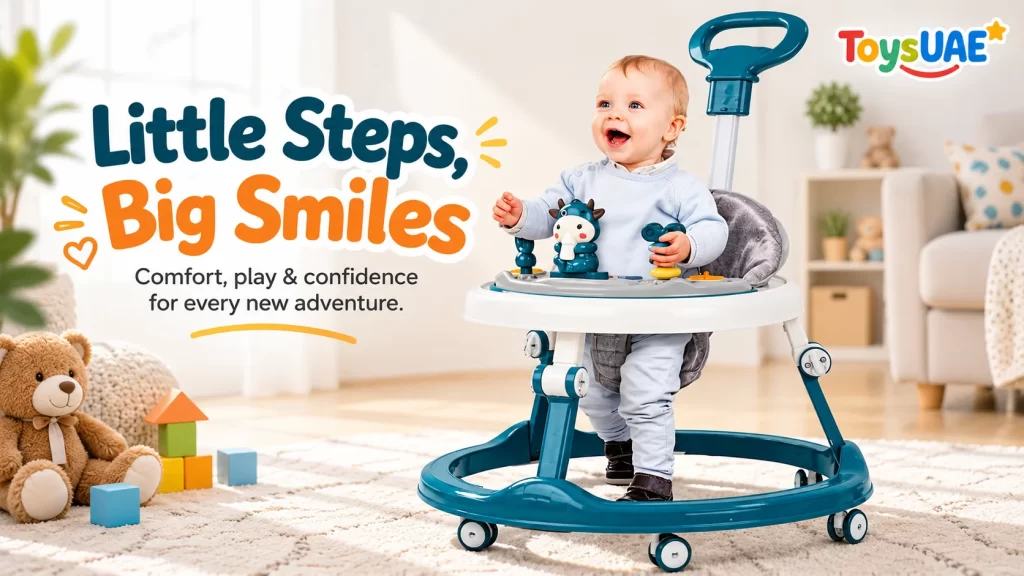
An activity walker can add to this kind of play when it includes age-appropriate toys and interactive features. Parents browsing ToysUAE can look for models that encourage babies to explore different shapes, sounds, buttons, and moving parts.
Learning Through Cause and Effect
One of the simplest forms of problem-solving is understanding cause and effect.
For example, a baby walker may press a button and hear a sound. After repeating the action, they begin to understand that pressing the button creates the result.
This kind of play helps babies connect actions with outcomes.
Exploring Different Ways to Use Toys
Activity panels often include several features that work in different ways.
A baby may need to:
- Turn a small wheel
- Slide a piece
- Press a button
- Lift a flap
- Move a shape
- Spin a toy
Trying different actions encourages babies to experiment.
They may not understand the activity immediately, but repeated attempts are part of the learning process.
Encouraging Curiosity
Problem-solving often starts with curiosity.
When babies see something new, they naturally want to know what it does.
An activity walker with several simple toys can give them different things to investigate.
Some babies may repeatedly return to one feature until they understand how it works, while others may move quickly between activities.
Both are normal ways of learning.
Helping With Memory
Repeated play can also support early memory.
A baby may remember that a certain button makes a sound or that turning one part makes another piece move.
Recognizing these patterns can help them understand how familiar activities work.
This is a simple but useful part of early learning.
Supporting Hand and Eye Coordination
Problem-solving also involves physical actions.
A baby may see a toy, decide to reach for it, and then work out how to move it.
This combines thinking with hand and eye coordination.
Interactive toys can therefore make learning more hands-on.
Learning Through Trial and Error
Babies often learn by trying something more than once.
They may push the wrong part first, try another movement, and eventually discover what works.
This trial-and-error process is an important part of early problem-solving.
Parents do not need to complete every activity for the baby. Giving them time to explore can make play more meaningful.
Simple Activities Work Well
Early learning does not require complicated toys.
Simple activity features can be enough to encourage thinking.
A spinning toy, sliding piece, shape activity, or sound button can help babies practice attention and experimentation.
Too many features at once may even become distracting, so a clear and easy-to-use design can be a good choice.
Parents Can Join the Play
Parents can make activity time more useful by interacting with their baby.
They can point to a toy, name a shape, show how one feature works, or encourage the baby to try again.
Simple words such as “push,” “turn,” “open,” and “close” can also connect movement with language.
The goal is to guide the baby without doing everything for them.
Keep Learning Varied
An activity walker should be one part of a wider play routine.
Other useful activities include:
- Building blocks
- Shape sorters
- Stacking toys
- Soft books
- Hide-and-find games
- Simple puzzles made for babies
- Floor play
Different activities give babies more opportunities to explore and think in new ways.
Choosing an Activity Walker at ToysUAE
Parents exploring ToysUAE can look for walkers with simple interactive features that match their baby’s stage.
Useful features may include:
- Easy-to-press buttons
- Turning pieces
- Sliding toys
- Different textures
- Simple shapes
- Gentle sounds
- Secure activity parts
The walker itself should also be stable, comfortable, and suitable for the baby’s age.
Can an Activity Walker Build Problem-Solving Skills?
An activity walker can provide opportunities for early problem-solving through simple play.
Pressing, turning, experimenting, repeating actions, and discovering how toys respond can all encourage basic thinking skills.
It should not be seen as the only learning tool, but it can be a useful addition to a varied play routine.
Final Thoughts
Problem-solving begins with small everyday experiences.
An activity walker can encourage babies to explore, test ideas, repeat actions, and discover simple cause-and-effect relationships.
Parents browsing ToysUAE can focus on activity walkers with clear, age-appropriate toys that invite interaction without making play too complicated.
Combined with floor play, books, blocks, and parent interaction, activity toys can help make early learning more interesting and enjoyable.