Coworking vs Virtual Office: What Early-Stage Founders Should Actually Pick
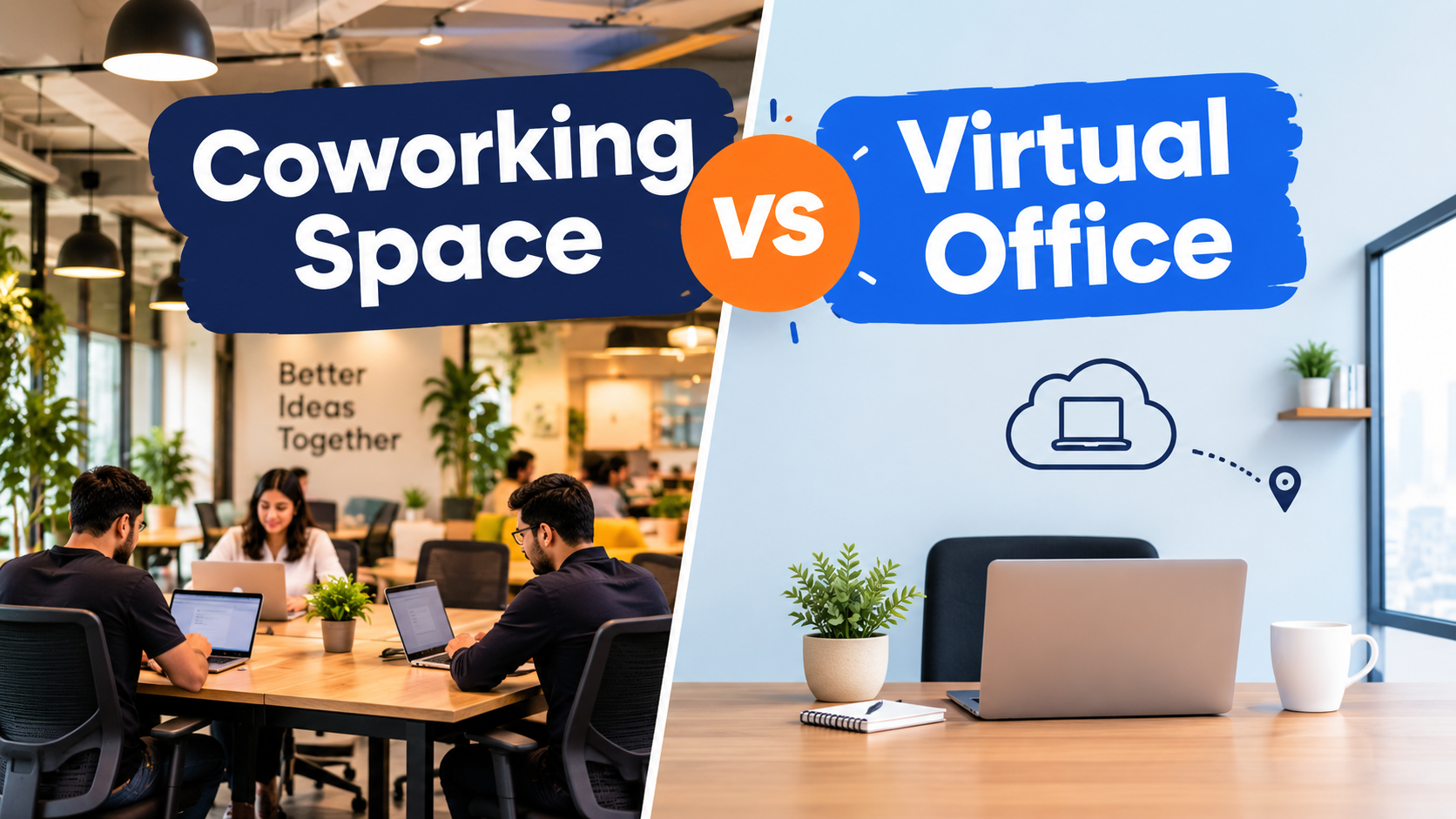
To start a business in India, what do early-stage entrepreneurs require: a desk or just an address? As a founder, you may have this doubt while applying for company formation in India. Well, the answer is not the same for every founder. Not understanding the difference between coworking vs. a virtual office can waste money or more worse, lead to the compliance burden during GST registration filing.
Let’s explore this comprehensive guide to know the difference between coworking vs. a virtual office, how a virtual office in India works, and cost criteria. Here’s a straight, no-fluff breakdown to help you decide.
Coworking vs Virtual Office: Core Difference
A virtual office in India is a smarter and cheaper choice for you if your goal is only to get a legal business address for company registration, a GST certificate, or to open a business bank account, with your team working remotely. Whereas coworking makes more sense when you require a place to sit for client meetings or want your staff to work together in person in the same place.
In short description:
- Just need paperwork sorted?– Go with a virtual office
- Need team, desks, and meetings?– Go with Coworking
In India, most of the early-stage entrepreneurs start with a virtual space to avoid the property heavy cost and once their operation upgrades or hired 3-4 staff with consistent meetings, they switch to coworking. This is considered a progressive way to start a business with low-cost investment and upgrade once it grows. Consider this table checklist to understand the legal and operational differences between coworking vs virtual office:
| Category | Virtual Office | Coworking Space |
| Purpose | GST registration, company registration, and legal compliance | Workplace operation management and professional meetings |
| Physical Presence | Not required; remote or work from home | Required; visit the place to use a dedicated desk |
| Services | Mail answering, call management, company address | Meetings, high-speed internet, printing & in-person work |
| Profile Cost | Typically lower monthly cost (ranging between ₹1,000 and ₹4,000) | Higher, ranging between ₹5,000 to ₹25,000 |
| Ideal for | Freelancers, consultants, or remote-first teams | Startups, growing businesses, or freelancers who need a routine office environment |
Cost Comparison: Virtual Office, Hot Desk & Dedicated Desk
During the initial business formation days, entrepreneurs struggle with financial challenges. To avoid financial crises, having clear and complete cost information for a virtual office or coworking set-up is crucial. However, the exact ranges vary by state and city. Here is the complete cost checklist:
- Virtual office Cost: The cost ranges between ₹1,000 and ₹5,000 per month, which entirely depends on the provider and the specific city. It generally includes mail handling, a registered office address, and sometimes managing meetings for a few hours per month or year. The annual package is marked as ideal rather than the monthly cost.
- Hot Desk (Coworking): Starts from ₹3,000 to ₹8,000 per month per seat or can be higher in India. At a coworking place, you get a shared, unassigned desk with high-speed internet and access to common areas.
- Dedicated Desk (Coworking): Typically ranges from ₹6,000 to ₹15,000 per month per seat, and in premium locations, the range of cost increases significantly. In a dedicated desk, you get your own fixed desk with storage, good internet speed, and better privacy to work.
Which One Is Ideal for Company Registration & GST?
Let’s clear up the doubts when you require a virtual office and coworking space:
Virtual Office for Company Registration
If you are going to incorporate a private limited company, LLP, or OPC in India, then you can use a virtual office as a registered office address. As per the MCA guidelines, having a valid registered office address is mandatory to receive official communication updates, but it is not required that you have to be a place where you work every day. To show the registered office address details to the MCA, you are required to obtain documents like a No Objection Certificate (NOC), rent agreement, and utility bill from the provider.
Virtual Office for GST Registration
Using the virtual office for GST registration is legally valid in India. It is marked as one of the most common reasons why founders register a virtual space. This is because a virtual space with proper documentation satisfies the “principal place of business” requirement for GST registration in most states. Before applying for a virtual office in India, you must ensure that the virtual space provider handles GST registration in your specific area.
Coworking for Registration and GST:
Coworking spaces are also applicable for company and GST registration. However, the applicant is required to obtain a valid formal agreement with the coworking space operator. But not every coworking space provider issues the agreement documents.
In conclusion, a registered office for startups through a virtual office is marked as the faster , chapter and sounds legal if your only goal is to maintain compliance and documentation burden.
Also read this blog – Airport Transportation Services
When Does a Coworking Space Make Sense?
Coworking is expensive compared to a virtual space, but it is useful in certain situations:
- You have a team that needs to collaborate daily for products or sales discussions.
- You require a better space to meet clients or investors often, as it makes a good impression.
- You are past the solo-founder stage, starting to hire staff with in-person operations meetings.
- You need infrastructure you can’t easily replicate at home, as it provides good networking, a corporate working environment, and printing and phone call facilities.
- Looking for good networking for your business, as most of the coworking places host founders, events, and communities.
If you relate to any of these, then investing in a coworking space is totally justified.
When is a Virtual Office Enough?
On the other hand, a virtual space is ideal when:
- Your team members are working from home, or you don’t have any staff; therefore, you do not require physical space.
- You are a solo founder and an in-home space is enough to operate.
- Your main goal is only to fulfil requirements like registering the company, opening a bank account, or applying for a GST number.
- You don’t have much budget to manage separate space expenses, as you are at an early stage of your business.
- You do not hold many meetings with clients, or you can book separate office rooms occasionally.
A virtual office address is considered ideal to be legitimate and compliant while applying for GST and company registration in India without locking up capital in rent.
Got Doubt? Clear with these FAQs!
Q1. Can I register as a virtual office for GST registration in Bengaluru?
Ans. Yes, you can use the virtual office in Bangalore to apply for GST registration in India, but you have to get the applicable documents from your provider.
Q2. What if I want my team fully remote?
Ans. For fully remote work operations, a virtual office setup is ideal for you.
Q3. What if I want to meet clients more than once a week?
Ans. Meeting with clients once a week is mandatory; then a coworking space with a dedicated seat is ideal, as it provides a professional space with good networking opportunities.
Q4. What is the virtual office cost in India?
Ans. The cost of a virtual office address in India ranges from ₹1,000 to ₹5,000 per month.
Q5. What documents are required when a GST officer visits my virtual office?
Ans. When a GST officer visits your virtual office, you must ensure that your provider shows the specific documents, such as virtual space address proof, business & identity documents, GST application files, and on-site setup details.

You may also like

Why Oil Change Oshawa Keeps Vehicles Running Smoothly

How Limo Services Airport Improve Your Travel Experience