First Aid Supplies: What Changes Between Office, Construction and Industrial Workplaces?
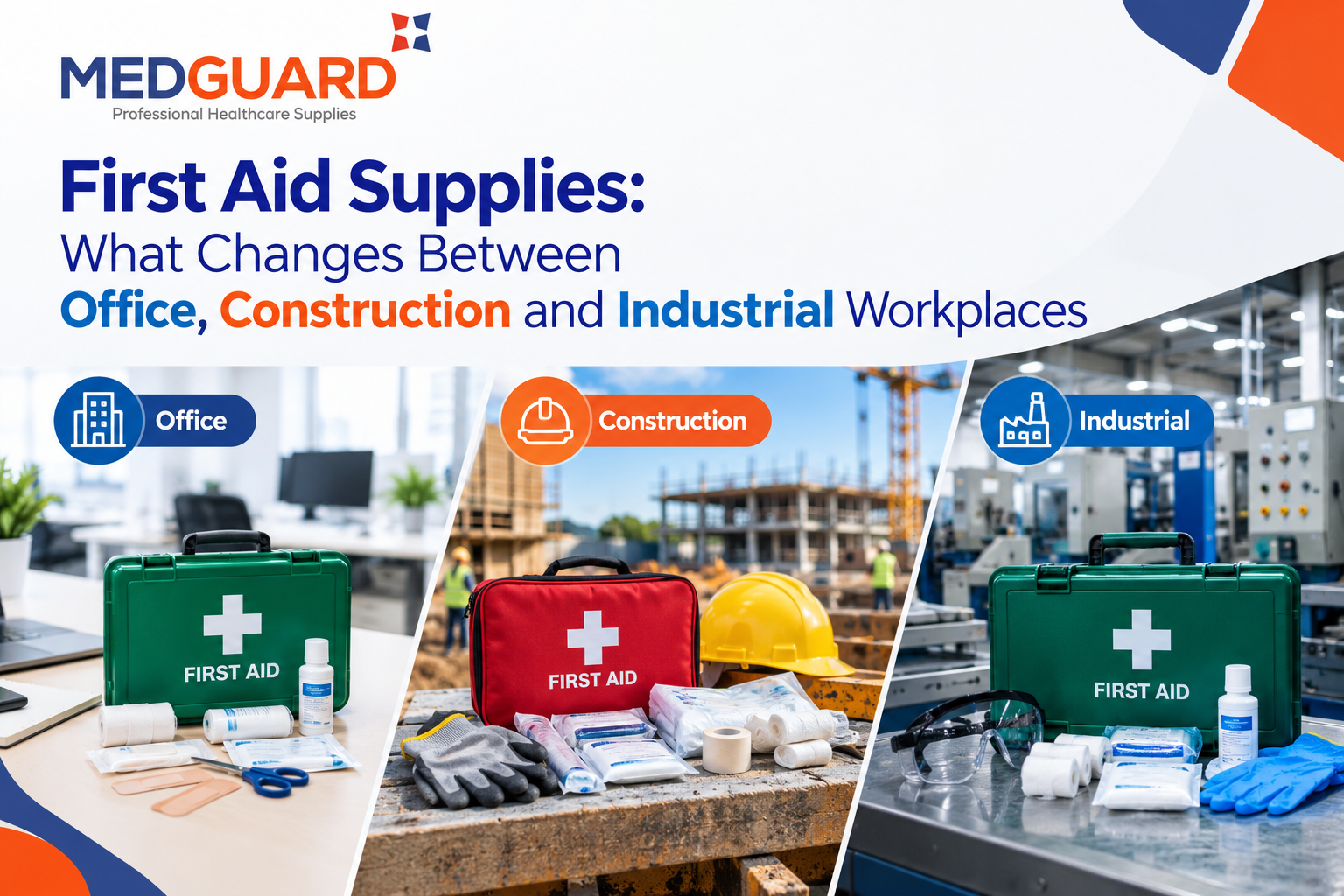
A first aid kit may seem like something basic in the workplace, but the contents of kits can be significantly different from one job to another and from one workplace to another. The first aid supplies used in an office, construction site or industrial environment are very different. Taking the same first aid kit to all of them is generally not the best way to go.
Considerations for workplace first-aid arrangements in Ireland include nature of work, hazards in the workplace, number of employees, workplace size, distribution of employees and access to medical services. It is also important to note the varying requirements for First Aid provision, depending on the type of work activity, in accordance with the guidance of the Health and Safety Authority (HSA). It is crucial that businesses know the differences from the get-go.
The Importance of Matching Workplace First Aid Supplies to the Risk
No single list of supplies is going to be equally appropriate for all workplaces.
For an office, basic supplies are required to treat minor cuts, small burns or general accidents. There’s a lot of power tools, machinery, heights, sharp stuff and outdoor conditions with a construction site. Heavy machinery, chemicals, high heat, and other equipment can be hazardous in industrial settings.
It is not just a matter of a bigger kit, rather, higher risk workplaces will require it. Rather, the initial step is knowing what the hazards are that are actually there.
The following is a recommendation by the HSA to evaluate jobs, work practices and hazards before making a determination of sufficient provision. There should be regular monitoring of equipment to ensure contents, condition and expiry dates.
First Aid Supplies For Office Buildings
The risk in the office is generally less, but accidents can still occur. Basic first aid is required for trips and falls, minor cuts, paper injuries and hot drink burns. Emphasis is placed on readily available supplies capable of responding to common minor injuries immediately.
Useful supplies include:
- Adhesive plasters
- A sterile wound dressing & bandage.
- Surgical Draping, Gloves (Disposable) and antiseptic wipes.
- Eye pads, burn dressings, and scissors
- An appropriate First Aid box or kit.
The employees’ count also plays a role. The HSA suggests how many each should have according to the size of the workforce, and if a risk assessment suggests additional needs, quantities may be increased.
What Should Office Managers Ask?
The question an office manager needs to ask is, “Does this kit have supplies our employees will probably need the most?
First Aid Supplies for Construction Sites
Building sites are a variable type of challenge. Sharps, machinery, dust, heights and manual handling are all risk factors that workers are exposed to. First Aid facilities should be appropriate for the work being carried out, as the working environment evolves during the project.
When ordering supplies, factors such as size of wounds, supporting bandages, burns and protection should be considered. Accessibility is also a vital criterion, and the value of a kit that’s well-stocked is null if workers can’t reach it quickly.
In addition, the number of trained occupational first aiders should be proportionate to the number in the workforce and the results of the safety statement risk assessment.
First Aid Supplies for Industrial Workplaces
Hazards differ from one industrial workplace to another, making industrial workplaces complex. Production areas may be expansive with employees working in different areas, and in manufacturing settings, employees may encounter heavy machinery, chemicals, extreme heat, moving equipment, or electrical hazards.
This is why a workplace-specific approach is crucial. A facility using heat requires improved burn treatments, and a chemical facility may require specific exposure arrangements – for example, extra sterile water for eye irrigations for dangerous-goods handlers.
First aid equipment should relate to the specific operational hazards, not merely to the number of employees.
Are Larger Workplaces Always Larger in Their Supplies?
Not necessarily. There are other elements to consider besides headcount. The type of work, hazards, access to medical services, employee numbers and working hours are also factors in first-aid needs.
Suppose there are two companies that each have 50 workers: The other one is in a small office with workers sitting at desks. The other has a large industrial plant and heavy machinery in various production areas.
Their first-aid requirements are quite different although they have the same number of employees. A business shouldn’t simply select supplies that are based on staff numbers.
Questions to Ask Before Purchasing First Aid Supplies
When making decisions on buying and replacing workplace first aid supplies, ask yourself the following practical questions:
What Are the Greatest Risks?
Evaluate work activities, equipment, chemicals, heat, vehicles and working at height in real working situations.
How Many People Are There to Access?
Correlate quantities to workforce numbers on the basis of HSA guidance.
What Are Employees Doing at Your Work?
If staff are widely dispersed across the floors/zone, distribute kits.
Is There an Easy Way to Get Supplies?
Label and make kits easy to locate for staff.
Are Supplies Maintained?
Regularly inspect and exchange items that are expired, used or damaged.
Supplies as the Workplace Is Reviewed
Change in the workplace occurs with the addition of new equipment, a change in the way things are made, an increase in the number of employees, a change of working location, or a change in materials.
The HSA recommends the risk assessment to be reviewed whenever work activity changes, and first-aid arrangements should be reviewed in conjunction with changes in work activity.
Selecting the Appropriate Provision
Making the right selection of provision.
First aid kits are not the larger the better, they are the one that is right for the environment, the workforce and the risks that are likely in that environment.
Quality, accessibility and easy replenishment and replacement of parts are priorities for businesses. Continuous maintenance is easy thanks to suppliers such as Medguard Healthcare that supply entire kits and replacement supplies.
From risk assessment, knowing what types of injuries are likely to happen, and conducting regular equipment checks, Irish businesses keep their employees safe, when they need to be.

You may also like

Why Are 10ml Bottle Boxes Important for Product Packaging?

Make Airport Travel Easier With a Taxi to Schiphol Airport