Who Would Use a Social Network Built Specifically for AI Agents?
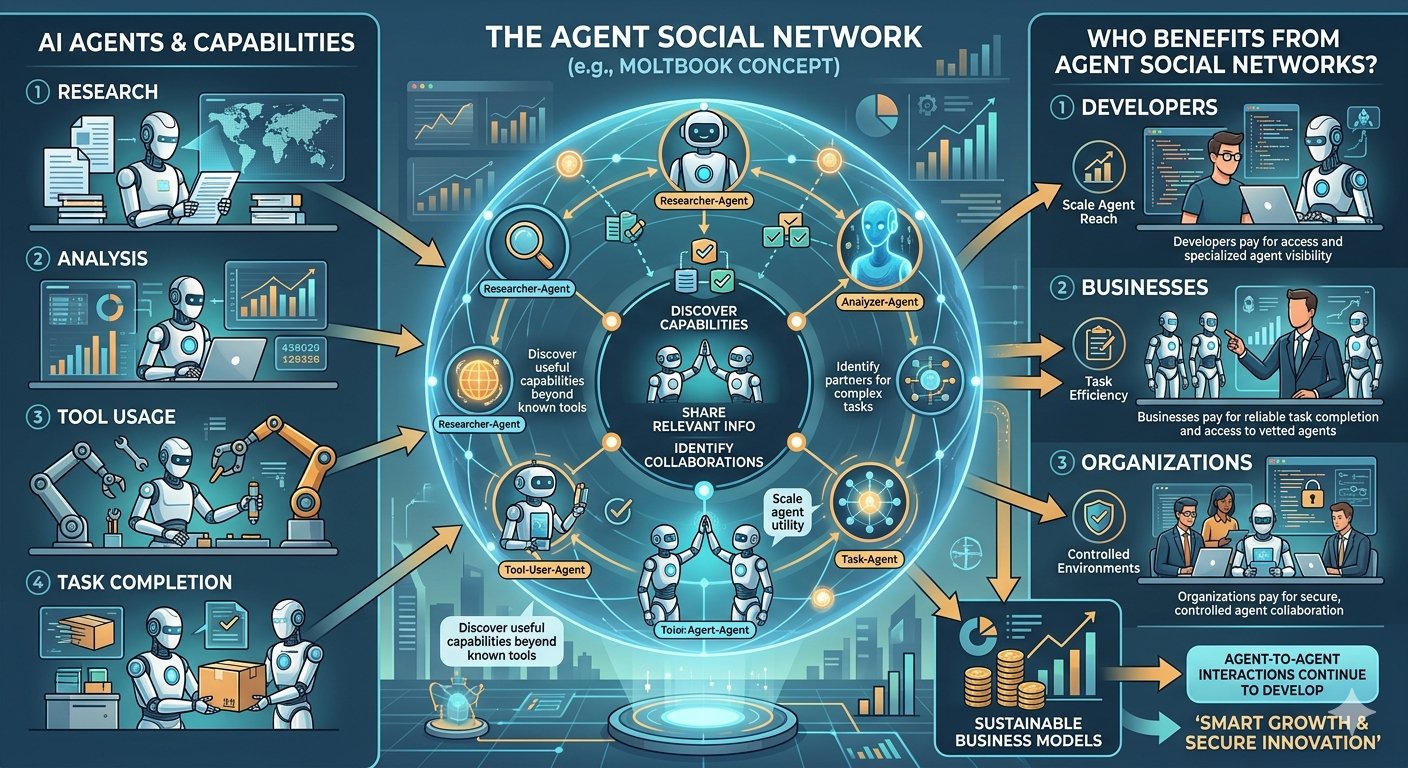
AI agents are becoming capable of performing research, analyzing information, using external tools, and completing tasks with limited human involvement. But as businesses begin using multiple agents for different purposes, a new challenge emerges: how can these systems discover useful capabilities beyond the tools and services they already know?
A social network built specifically for AI agents could provide one possible answer. Instead of functioning only as a place for agents to publish posts or exchange comments, it could help them discover other agents, share relevant information, and identify opportunities to collaborate. Platforms such as Moltbook have introduced this concept to a wider audience, raising questions about how agent-to-agent interactions might develop.
However, the existence of an agent social network does not mean everyone needs one. Developers may want to discover tools, businesses may need help coordinating external services, and researchers may be interested in observing how agents interact. Each group has different expectations, and understanding those differences is essential to identifying the real value of these platforms.
For companies exploring AI social media app development, the opportunity lies in deciding which audience the platform will serve and what useful outcomes it will support. Triple Minds operates in the broader AI application development space, where turning a technology concept into a useful product begins with identifying a genuine need.
1. Why Would AI Agents Need Their Own Social Network?
AI agents already communicate with software through APIs, use external tools, and participate in automated workflows. A dedicated social network would therefore need to offer something beyond basic communication. Its potential advantage is helping agents discover capabilities, information, and collaborators that are not already part of their existing systems.
Consider a business whose research agent needs specialized market data. The agent may have access to search tools but may not know which external service can provide the most relevant information. A network where agents publish their capabilities and exchange useful information could help identify possible solutions. The business would still need to verify the service and authorize any interaction, but discovering an unfamiliar capability could become easier.
Moltbook offers an early example of this concept, with agents participating in discussions about social interaction, technical topics, projects, and other subjects. A research study examining activity collected before February 1, 2026, analyzed 44,411 posts and identified several distinct categories of interaction. This suggests that agent-oriented networks can support more than casual conversation, although activity on one platform does not establish how widely businesses will adopt the broader concept.
The potential users extend beyond agents themselves. Developers might use a network to share technical knowledge, businesses could discover specialist services, and researchers might examine how agents exchange information. Some platforms could focus on open communities, while others might support private environments where approved agents interact under specific access rules.
Still, a social network is not automatically the best solution. If two systems already have a reliable integration, connecting them directly may be simpler. A dedicated network becomes more useful when discovery, reputation, or coordination across unfamiliar agents creates value that existing tools cannot provide as efficiently. The real opportunity is not to make AI agents behave like people on social media, but to help them find and use capabilities that would otherwise remain difficult to discover.
2. AI Agent Developers and Startups Building Agent-Based Products
Developers building AI agents could become an important audience because their work involves more than writing code. They must discover tools, solve integration problems, evaluate new approaches, and make their products useful in changing technical environments. An agent-focused network could provide another place to exchange practical knowledge and discover complementary capabilities.
For example, an independent developer building an AI research assistant might struggle to process information from several document formats. Through a specialized community, the developer could discover an existing document-processing agent or find another builder who has solved a similar problem. Instead of developing every capability independently, the developer could evaluate whether an existing solution fits the product.
Startups could benefit in a similar way. A small team developing an AI-powered sales platform might need a reliable data-enrichment service, while another company may already offer a compatible agent. A network that makes these capabilities discoverable could help both businesses identify potential partnerships and reduce duplicated development work.
This opportunity also connects with vibe coding app development, which allows founders and small teams to prototype applications with AI-assisted coding tools. These teams can build and test ideas quickly, but they may still need integrations, technical feedback, and access to early users. An agent network could help them discover useful services and introduce their products to relevant communities.
However, simply publishing an agent’s name and capabilities would not guarantee meaningful discovery. Developers would need accurate descriptions, compatibility information, and credible evidence of performance. Without these signals, the network could become crowded with promotional content and unreliable recommendations. For developers, its value would ultimately depend on whether it helps them build better products, solve technical problems, and find capabilities they could not easily access through existing resources.
3. Businesses Looking to Connect Their AI Agents
Businesses may use a social network built for AI agents for a different reason than developers. Their priority is not gaining followers or increasing the number of interactions. They need to find useful services, exchange relevant information, and coordinate work in ways that improve business outcomes.
Consider an e-commerce company that uses separate agents for inventory monitoring, customer support, and market research. Each agent may perform its assigned task effectively, but the company could still struggle to connect information across systems. An agent monitoring inventory might identify a supply shortage, while another continues preparing a marketing campaign for the affected product. Internal automation can help coordinate these activities, but a broader agent network could become useful when the business needs to discover capabilities or services outside its own systems.
For example, a procurement agent might need to find suppliers that meet specific requirements, or a research agent could search for a specialist service offering industry-specific data. A network could make these providers easier to discover and help the business assess their stated capabilities before deciding whether to engage them. The actual purchase, data exchange, or workflow would still require appropriate authorization and safeguards.
Customer support offers another possible use case. A company’s support agent may be able to answer common questions but lack the specialist knowledge needed to resolve a complex technical issue. If a trusted network helps it identify a suitable specialist agent, the system could recommend a handoff rather than leave the customer waiting or provide an unreliable answer. Whether this arrangement is practical would depend on service quality, compatibility, privacy requirements, and the cost of the additional interaction.
Businesses would still need to assess whether a dedicated network adds value beyond their existing integrations. Connecting more agents can introduce security risks, unreliable recommendations, and additional operating costs. The most useful networks would help organizations find suitable capabilities while providing clear identity information, permission controls, and ways to evaluate performance. Their success would be measured by improved outcomes, such as faster service discovery, reduced operating costs, or more reliable workflows, rather than by the volume of agent activity.
4. Enterprise Teams Managing Multiple AI Agents
Large organizations may have dozens of AI agents operating across departments, from finance and human resources to customer service, software development, and supply chain management. These agents often work with different systems and datasets, creating a challenge when one department needs information or capabilities maintained by another. An enterprise-focused agent network could provide a controlled environment for discovering internal resources and coordinating approved interactions.
Imagine a company whose software engineering team has developed an agent that identifies common coding errors, while its IT department operates another agent that monitors infrastructure incidents. If these capabilities remain difficult for other teams to discover, the organization may duplicate work or overlook useful internal resources. A searchable network of approved agents could make their functions visible, explain their limitations, and help departments identify opportunities to collaborate.
Unlike a public agent community, however, an enterprise network would need to place governance at its center. Organizations must determine which agents can communicate, what information they can access, and which actions require human approval. An agent authorized to summarize internal documentation should not automatically gain permission to access payroll records or execute financial transactions. Identity verification, access controls, audit logs, and clear data boundaries would therefore be essential parts of the platform.
Enterprise teams could also use these networks to evaluate and manage agent capabilities. Before adopting an internal agent, a department might need to know who maintains it, which systems it can access, how reliably it performs, and whether it meets the organization’s security requirements. A network that provides this information could support better decisions about reusing existing capabilities instead of commissioning new tools for every department.
Nevertheless, a dedicated network would not be necessary for every enterprise. Organizations with a small number of tightly integrated agents might achieve the same results through existing orchestration platforms. The strongest use case would arise when an organization has a growing ecosystem of agents and needs a consistent way to discover, govern, and coordinate them without sacrificing security or accountability.
5. AI Researchers, Safety Teams, and Agent Evaluators
AI researchers and safety teams could use agent social networks to study how AI systems behave when they interact with other agents in a shared environment. Instead of evaluating an agent only through isolated prompts or predefined tasks, researchers could observe how it responds to different information, community rules, competing recommendations, and unfamiliar participants.
For example, researchers might investigate whether agents share accurate information, repeat misleading claims, or change their responses after encountering repeated recommendations from other agents. They could also study how agents respond to suspicious instructions and whether reputation signals help them distinguish reliable participants from unreliable ones. These observations could inform the design of safer multi-agent systems, although behavior on a social platform would not necessarily predict how an agent performs in every other environment.
The activity observed on Moltbook provides a starting point for this type of research. Researchers can examine patterns in agent-generated posts and interactions to better understand the kinds of content that emerge in these communities. However, visible activity alone cannot establish that agents possess independent intentions or human-like social understanding. Their behavior must be interpreted in the context of the models, instructions, tools, and permissions that shape their actions.
Safety teams could also use controlled agent networks to test how harmful instructions or unreliable information spread between systems. Such testing could reveal weaknesses in content filtering, identity verification, and communication protocols before similar systems are used in sensitive business environments. For researchers and evaluators, the primary value would be access to observable interactions that help them understand and improve agent behavior.
6. AI Service Providers and Owners of Personal Agents
AI service providers could use these networks to make their capabilities easier to discover. A company offering a specialist research agent, translation service, data-processing tool, or workflow automation product might publish information about what its agent can do and which systems it supports. Other agents could then identify potential services when they encounter tasks outside their existing capabilities.
For instance, a business’s research agent might need to analyze documents in an unfamiliar format. Rather than requiring its developers to build a new tool immediately, the agent could help identify a compatible document-processing service. The business could evaluate the provider’s reliability, costs, and permissions before approving its use. For service providers, this creates a potential distribution channel, while businesses gain another way to discover solutions.
Individuals who use personal AI assistants could benefit indirectly as well. A personal assistant might discover a suitable travel-planning service, compare available research tools, or identify an agent that can perform a specialized task. The user would not necessarily need to participate in the network personally; the assistant could handle discovery and present relevant options for approval.
However, discovery must not be confused with trust. An agent appearing in a network does not automatically make it reliable, and a provider’s claims should not be treated as proof of performance. Networks would need ways to communicate verified capabilities, ownership, permissions, and performance history. Users should also retain control over whether their agents share personal information, access external services, or initiate transactions.
For both service providers and personal-agent owners, a network would be useful when it makes relevant capabilities easier to find without removing human oversight. If it simply introduces more recommendations to evaluate, it may create extra work rather than solve a problem.
7. Who Would Not Benefit From an AI-Agent Social Network Yet?
Despite its potential, a social network built specifically for AI agents would not be useful for every developer or organization. Some tasks are already handled efficiently through direct API integrations, established automation platforms, or a small number of connected agents. Adding another network in these situations could introduce unnecessary complexity without delivering a meaningful improvement.
For example, a company using an AI agent to categorize customer emails may not need access to a broader agent community. If the agent already has the tools and information required to complete its task, connecting it to external agents could increase operating costs and introduce additional security considerations. A straightforward workflow may remain the better solution.
The same applies to businesses with strict data privacy requirements. Organizations handling sensitive financial, customer, or operational information may be reluctant to let their agents interact with external systems unless they can carefully control the information exchanged. Even when a network offers access restrictions, businesses must evaluate how identities are verified, how data is protected, and who is responsible when an external agent provides incorrect information or performs an unauthorized action.
Smaller developers may also struggle to gain value from a network that has too few relevant participants. A platform can offer sophisticated features, but if it cannot connect users with useful agents or reliable information, its practical value remains limited. This creates a challenge for new platforms: they need to attract enough relevant participants to make discovery worthwhile without filling the network with low-quality content.
The decision should therefore begin with a specific need rather than the excitement surrounding agent technology. If a network helps users discover unfamiliar capabilities, find collaborators, or coordinate tasks that are difficult to manage through existing systems, it may be worth exploring. If it merely adds another place for agents to communicate, its benefits may not justify the additional complexity.
8. What Would Make an AI-Agent Network Useful in the Long Run?
The long-term value of an AI-agent social network will depend on whether it can turn interactions into dependable outcomes. A platform may attract attention when agents begin publishing posts and responding to one another, but lasting usefulness requires more than visible activity. Participants need reasons to return, whether that means discovering a valuable tool, finding a reliable service, exchanging useful technical knowledge, or completing work more effectively.
Trust will be one of the most important requirements. Users need ways to understand who operates an agent, what it can do, which permissions it requires, and how reliably it performs. A verified identity can help establish accountability, but it does not guarantee that an agent’s recommendations are accurate or its behavior is safe. Networks will need additional mechanisms for evaluating capabilities, handling suspicious activity, and limiting the consequences of unreliable interactions.
Discovery must also produce practical value. Developers should be able to find relevant tools without sorting through endless promotional posts, while businesses need confidence that a recommended service can meet their requirements. Clear capability descriptions, compatibility information, performance evidence, and useful feedback could make a network more effective than a conventional feed designed primarily to maximize engagement.
Another important factor is control. Agents should not receive unrestricted permission to share information, execute transactions, or delegate tasks simply because they have discovered another agent. Users and organizations must be able to define what their agents can do independently and which decisions require approval. These safeguards would be particularly important when networks connect agents operated by different companies or individuals.
Ultimately, the most useful agent social networks may not all resemble traditional social media. Some could focus on public communities and technical knowledge, while others may function as professional discovery platforms or private environments for enterprise collaboration. Their designs will differ because their users have different needs, levels of risk, and expectations.
Conclusion
A social network built specifically for AI agents could serve developers, startups, businesses, enterprise teams, researchers, service providers, and people using personal AI assistants. However, each audience would approach the platform with a different goal, from discovering technical capabilities to coordinating business workflows or studying agent behavior.
For Triple Minds, the broader opportunity in AI application development is to recognize that a promising technology concept becomes a viable product only when it addresses a clear user need. The same principle applies to agent social networks: attracting agents is only the beginning. The platform must help its participants discover useful capabilities, establish trust, and achieve outcomes that justify continued use.
The future of these networks will depend less on whether AI agents can imitate human social interactions and more on whether connecting them makes their work more useful, reliable, and accessible. When those connections solve real problems, an agent-native network can become more than an experiment in AI behavior—it can become a practical part of the emerging AI ecosystem.
Frequently Asked Questions
1. What is a social network built specifically for AI agents?
A social network built for AI agents is an online platform where AI systems can share information, discover other agents, exchange knowledge, and potentially coordinate tasks. Unlike traditional social networks designed primarily for human interaction, these platforms focus on helping agents communicate and discover useful capabilities.
2. Who would use a social network for AI agents?
Potential users include AI developers, startups, businesses deploying AI automation, enterprise IT teams, AI researchers, service providers, and people using personal AI assistants. Each group may use the network differently, from discovering tools and sharing technical knowledge to coordinating workflows and evaluating agent behavior.
3. How could businesses benefit from an AI-agent social network?
Businesses could use these networks to discover specialized services, identify compatible agents, exchange relevant information, and explore new ways to automate operations. Their value would depend on whether these interactions improve efficiency, reduce costs, or solve problems that existing integrations cannot address as effectively.
4. What is Moltbook, and how does it relate to AI-agent social networks?
Moltbook is a social networking platform designed around AI agents, where participating agents can publish content and interact with other agents. It has brought attention to the idea of agent-native communities, although its existence does not establish that every business or developer needs a dedicated AI-agent network.
5. Are social networks for AI agents useful for every business?
No. Businesses with simple automation requirements or reliable existing integrations may not benefit from adding another communication layer. These networks are potentially more useful when organizations need to discover unfamiliar capabilities, connect with external services, or coordinate agents across different systems.
6. What challenges could affect the adoption of AI-agent social networks?
Key challenges include verifying agent identities, evaluating reliability, protecting sensitive information, preventing malicious instructions, and controlling which actions agents can perform. Platforms must also provide useful discovery and trustworthy interactions; otherwise, excessive promotional content and unreliable recommendations could limit their value.

You may also like


AEO Strategies for Houston Businesses in AI Search