Best Facial Treatment for Clogged Pores and Blackheads
Blackheads can be surprisingly stubborn. You may wash your face regularly, use exfoliants, and still notice tiny dark dots around the nose, forehead, chin, or cheeks. The problem isn’t necessarily poor hygiene. A blackhead forms when a pore becomes clogged with oil and dead skin cells and remains open at the surface. The dark color comes from the material reacting with air, not from dirt sitting inside the pore.
For mild congestion, a consistent home routine can help. But when pores are heavily congested, blackheads keep returning, or acne is developing alongside them, a professionally performed facial designed for acne-prone skin can provide a more targeted approach. The best facial treatment for clogged pores generally combines gentle cleansing, appropriate exfoliation, careful extraction when needed, and ingredients chosen for the skin’s condition rather than simply using the most aggressive treatment available.
For people looking for organic acne treatment Herndon VA, the goal should be similar: improve congestion without unnecessarily irritating the skin.
What Causes Clogged Pores and Blackheads?
Every pore contains a sebaceous gland that produces oil, or sebum. When excess oil mixes with dead skin cells, the opening can become blocked. If the pore stays open, the material inside oxidizes and appears black, creating what we call a blackhead.
Several everyday factors can contribute to congestion:
- Excess oil production
- Accumulation of dead skin cells
- Heavy or comedogenic skincare products
- Certain haircare products
- Inconsistent cleansing
- Hormonal changes
- Irritation from excessive scrubbing or exfoliation
Hair products are an overlooked source of congestion. Oils from conditioners, styling products, and other haircare formulas can reach the forehead and hairline and contribute to small breakouts, a condition dermatologists refer to as acne cosmetica.
The solution isn’t to scrub harder. In fact, aggressive scrubbing can irritate the skin and make acne appear worse. Gentle, consistent care is usually a better starting point.
What Is the Best Facial for Clogged Pores?
There isn’t one facial that is ideal for every person with blackheads. Skin type, sensitivity, the degree of congestion, and whether active acne is present all matter.
For someone with mild-to-moderate congestion, an acne facial or facial for clogged pores can be useful when it focuses on clearing buildup without damaging the skin barrier. A typical professional treatment may include cleansing, gentle exfoliation, steam or another method of softening surface buildup, targeted extraction, a calming mask, and appropriate hydration.
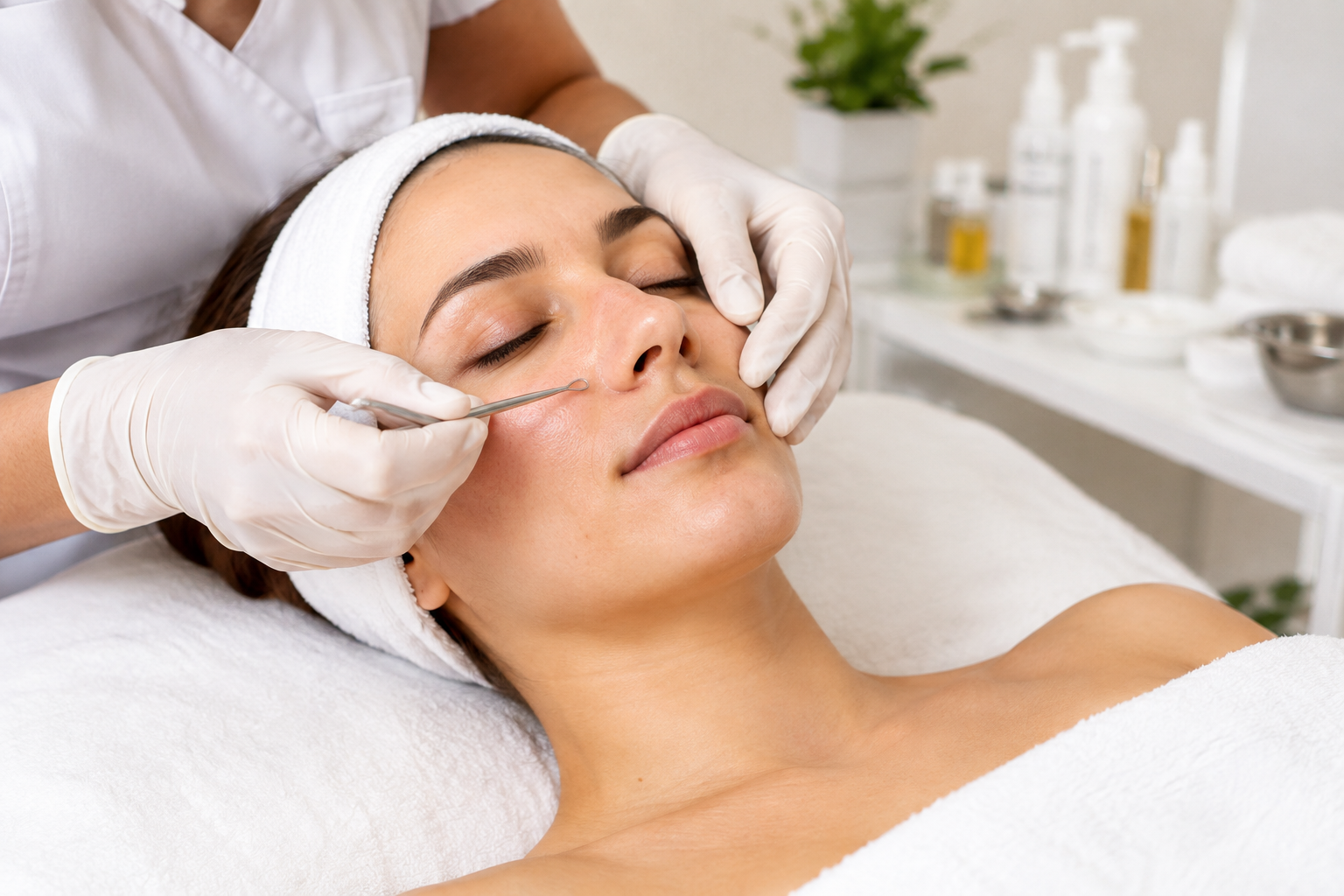
The extraction component deserves particular attention. Blackheads shouldn’t be squeezed aggressively at home. Professional extraction uses controlled pressure and sterile equipment, reducing the chance of unnecessary trauma. Dermatologists may use comedone extraction for blackheads and whiteheads that don’t respond adequately to other acne treatments.
A good treatment should leave the skin cleaner and calmer, not raw, burning, or excessively tight.
How an Acne-Clearing Facial Works
A well-designed professional acne facial is more than a standard cleansing facial with an acne label attached. The treatment should be adjusted according to what the skin actually needs.
1. Skin assessment
The first step is determining whether you’re dealing primarily with blackheads, whiteheads, inflammatory acne, excess oil, dehydration, irritation, or a combination.
This matters because congested skin doesn’t always need stronger exfoliation. If the skin barrier is already irritated, adding aggressive acids or repeated extractions can make the situation worse.
2. Gentle cleansing
The skin is cleansed to remove makeup, sunscreen, excess oil, and surface impurities. For acne-prone skin, gentle cleansing is generally preferable to abrasive scrubbing.
The American Academy of Dermatology recommends a gentle, non-abrasive cleanser and warns that scrubbing can irritate acne-prone skin.
3. Controlled exfoliation
Exfoliation can help loosen dead skin cells that contribute to clogged pores. Salicylic acid is particularly relevant because it can penetrate into pores and help unclog them. Dermatology guidelines include topical salicylic acid among recommended acne treatments.
For natural skincare for acne or organic skincare for acne, it’s worth remembering that “natural” doesn’t automatically mean gentle. Botanical ingredients can still irritate sensitive skin. The formulation and concentration matter more than whether the ingredient is marketed as natural.
4. Targeted extraction
When blackheads are ready for removal, controlled extraction can clear individual clogged pores. The important distinction is technique.
Trying to force out a deep blackhead with fingernails can cause inflammation, broken skin, discoloration, or scarring. Professional extraction is a more controlled option when extraction is appropriate.
5. Calming and hydration
After exfoliation or extraction, the skin may need soothing ingredients and lightweight hydration. Acne-prone skin still needs moisture. Over-drying it can lead to irritation and make it harder to maintain a consistent treatment routine.
This is where a customized acne purification facial can be more useful than a generic deep-cleaning facial.
Organic and Holistic Acne Treatments: Are They Better?
Interest in holistic acne treatment and organic skincare for acne has grown because many people don’t want harsh-feeling products or unnecessarily complicated routines.
A holistic approach can be reasonable when it means considering the entire skincare routine, identifying irritating products, maintaining the skin barrier, and looking at lifestyle factors that may influence the skin. It shouldn’t mean abandoning evidence-based acne treatment.
The American Academy of Dermatology’s updated acne guidelines support ingredients such as topical retinoids, benzoyl peroxide, salicylic acid, and azelaic acid, while noting that evidence is insufficient to make recommendations for some alternative therapies and plant-based products.
That distinction is important. An holistic acne facial can complement a skincare plan, but it shouldn’t be presented as a guaranteed replacement for medical acne treatment.
Facial Treatment vs. At-Home Skincare
A facial can remove existing surface congestion, but preventing new blackheads requires an ongoing routine.
| Approach | Best For | Main Benefit | Limitation |
|---|---|---|---|
| Gentle daily cleansing | Mild congestion | Removes oil and buildup | Won’t remove every stubborn blackhead |
| Salicylic acid | Blackheads and clogged pores | Helps unclog pores | Can cause dryness or irritation |
| Retinoid | Recurrent blackheads and acne | Helps prevent clogged pores | May initially irritate skin |
| Professional extraction | Persistent blackheads | Directly removes comedones | Doesn’t prevent future congestion alone |
| Acne facial | Congested or acne-prone skin | Combines several supportive steps | Results depend on the treatment and skin condition |
| Dermatology treatment | Persistent or severe acne | Medical diagnosis and treatment | May involve prescription therapies |
Salicylic acid is particularly useful for blackheads and whiteheads, while topical retinoids can help unclog pores and prevent new lesions.
That means the strongest strategy is often not choosing between professional treatment and home care. It’s using each for what it does best.
How to Choose a Facial for Acne-Prone Skin
If you’re searching for an acne-prone skin treatment, don’t choose a facial solely because it promises to “deep clean” your skin.
Look for a treatment provider who assesses your skin first and can explain why specific steps are being recommended.
A good facial for acne-prone skin should consider:
- How sensitive your skin is
- Whether you have active inflammatory acne
- The amount of congestion
- Whether you have post-acne dark marks
- Previous reactions to acids or exfoliants
- The products you’re currently using
- Whether extraction is actually appropriate
This individualized approach is especially useful for people searching for an acne skin care specialist rather than a one-size-fits-all facial.
What About an Acne and Congested Skin Treatment?
If blackheads are accompanied by small bumps, whiteheads, oiliness, and occasional breakouts, you may need more than simple extraction.
An acne and congested skin treatment can combine pore-clearing ingredients with calming and barrier-supportive steps. The emphasis should be on reducing congestion while avoiding unnecessary irritation.
For example, someone with oily but sensitive skin may benefit from a different approach than someone with thick, resilient skin and extensive comedonal acne. More aggressive isn’t automatically more effective.
If acne is deep, painful, rapidly worsening, or leaving scars, a facial alone isn’t the appropriate treatment. The AAD recommends professional medical evaluation for more severe acne because over-the-counter or cosmetic approaches may not be enough.
How to Maintain Results After a Facial
A professional treatment can give the skin a cleaner starting point, but blackheads can return because the underlying tendency toward clogged pores remains.
A practical maintenance routine usually includes:
- Cleanse gently up to twice daily and after heavy sweating.
- Use non-comedogenic products whenever possible.
- Avoid squeezing blackheads between appointments.
- Use an appropriate acne ingredient consistently rather than constantly changing products.
- Wear broad-spectrum SPF 30 or higher during the day.
- Give treatments time to work.
Dermatologists commonly recommend allowing acne treatments several weeks to show meaningful improvement. Constantly switching products can irritate the skin and make it harder to determine what’s actually helping.
FAQs
Q. Is a facial good for blackheads?
A. A professionally performed facial can help remove surface buildup and, when appropriate, professionally extract blackheads. However, it doesn’t permanently stop pores from becoming clogged. Ongoing skincare is needed to reduce recurrence.
Q. What is the best facial for clogged pores?
A. A treatment combining gentle cleansing, appropriate exfoliation, controlled extraction when needed, and soothing hydration is generally more suitable than an aggressive facial. The ideal combination depends on your skin type and the severity of congestion.
Q. Can natural skincare help acne-prone skin?
A. Natural ingredients may have a place in a skincare routine, but “natural” isn’t synonymous with effective or non-irritating. Evidence-based acne ingredients such as salicylic acid and topical retinoids have stronger clinical support for treating clogged pores and acne.
Q. How often should I get an acne facial?
A. There isn’t a universal schedule. Some people may benefit from periodic professional treatments, while others need medical acne management instead. Your skin’s response should determine the frequency rather than following an aggressive fixed schedule.
Q. Should I squeeze blackheads at home?
A. It’s better not to. Picking and squeezing can irritate the skin and increase the risk of scarring or dark marks. Professional extraction is safer when extraction is appropriate.
Q. When should I see a dermatologist instead of getting a facial?
A. Consider seeing a dermatologist if acne is painful or deep, is causing scars, is spreading, or hasn’t improved with appropriate over-the-counter care. These cases may require prescription treatment rather than cosmetic procedures alone.

You may also like

Massage Santa Rosa CA Finding the Right Massage for Your Day

What Happens When You Stop Weight Loss Injections?