How to Choose Expert Jacket Back Digitizing Services for Large Designs
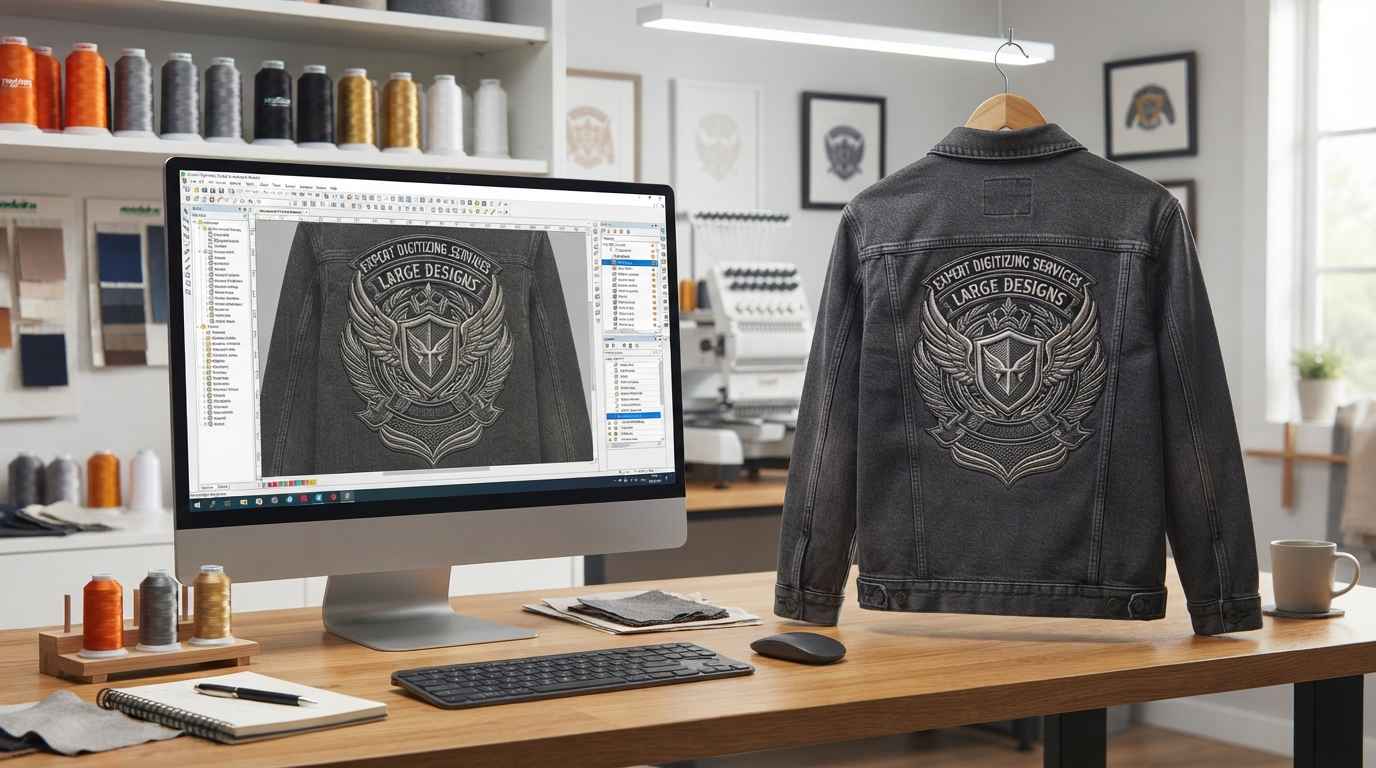
Large jacket back embroidery can turn a logo, illustration, team emblem, or custom artwork into a detailed garment design. However, large embroidery requires more planning than a small chest logo. The size, stitch count, fabric, lettering, and overall design structure can all affect the final result.
Choosing the right expert jacket back digitizing services is therefore an important step before sending a large design for production. A provider should understand how to convert artwork into an efficient embroidery file while maintaining clarity and controlling stitch density.
A good digitizing provider does more than convert an image into a machine file. The digitizer needs to consider how the design will behave on the actual jacket and make technical decisions that support clean embroidery.
This guide explains what to look for when choosing jacket back digitizing services for large designs.
Why Large Jacket Back Designs Need Professional Digitizing
A large design can contain thousands of stitches and several layers of thread. If the file is poorly prepared, problems may appear during production.
Common issues include:
- Excessive stitch density
- Fabric puckering
- Thread breaks
- Uneven coverage
- Poor lettering
- Unnecessary thread trims
- Distorted shapes
- Excessive stitch count
Professional digitizing helps address these issues before the design reaches the embroidery machine.
1. Look for Experience With Large Designs
The first thing to check is whether the provider has experience with large embroidery artwork.
A provider may have experience with small logos but limited experience with large jacket back designs. These projects require different considerations because of the larger embroidery area and higher number of stitches.
Review the provider’s portfolio and look specifically for large back designs.
Pay attention to:
- Large lettering
- Detailed graphics
- Multiple colors
- Filled areas
- Borders
- Large logos
- Complex artwork
A portfolio with relevant examples gives you a better idea of whether the provider can handle your project.
2. Review the Quality of Their Portfolio
Do not judge a portfolio only by the artwork itself. Look at how the embroidery appears.
Check whether lettering is readable and whether large filled areas have consistent coverage. Look at borders and outlines for smoothness.
If the provider shows both original artwork and embroidered results, compare them to see how effectively the design was adapted for stitching.
A strong portfolio should demonstrate technical control as well as visual quality.
3. Ask How They Handle Large Stitch Areas
Large jacket back designs can contain substantial filled areas.
These areas need appropriate stitch density and direction. If too many stitches are concentrated in one location, the design may become unnecessarily heavy.
Ask the provider how they approach large fill areas and whether stitch count is optimized for the design.
Efficient stitch planning can help reduce production time while maintaining suitable coverage.
4. Check Their Approach to Stitch Density
Stitch density should be selected according to the artwork, fabric, and design size.
Too little density can cause poor coverage, while excessive density can increase thread usage and place unnecessary stress on the fabric.
A professional provider should be able to explain how density is adjusted for different materials and design elements.
For large jacket back designs, this becomes especially important because a small density problem can affect a large section of the garment.
5. Ask About Underlay
Underlay provides support beneath the visible embroidery stitches.
The appropriate underlay can depend on the jacket material, design structure, stitch type, and coverage requirements.
Ask whether the provider considers the fabric before choosing underlay settings.
Using the same settings for every jacket is not an ideal approach because denim, nylon, polyester, canvas, and other materials can behave differently during embroidery.
6. Consider Their Experience With Different Fabrics
The jacket material can influence how the embroidery file should be prepared.
For example, denim can provide a relatively stable surface, while lightweight or flexible materials may require additional consideration.
When contacting a provider, tell them what type of jacket you plan to embroider.
This allows the digitizer to consider factors such as:
- Fabric stability
- Thickness
- Stretch
- Surface texture
- Required stabilization
- Stitch density
7. Evaluate Their Lettering Quality
Large jacket back designs frequently contain names, slogans, team names, business names, or other text.
Lettering should remain readable and visually balanced.
A provider should understand how different fonts behave when converted into stitches. Very thin strokes or tightly spaced characters may require adjustment.
Ask to see examples of large embroidered lettering in the provider’s portfolio.
8. Ask About Stitch Sequencing
The order in which design elements are embroidered can affect production efficiency and the final appearance.
Good sequencing can reduce unnecessary movement and thread trims while helping different sections connect correctly.
For a large design with multiple colors and overlapping areas, sequencing becomes particularly important.
A provider should have a clear approach to organizing the stitch sequence instead of simply tracing the artwork.
9. Check How They Handle Overlapping Areas
Large artwork can contain multiple overlapping shapes and colors.
If these areas are not planned properly, gaps or excessive stitching may occur.
A professional digitizer can use controlled overlaps where needed to maintain coverage and prevent unwanted fabric gaps.
At the same time, excessive overlap can increase density, so the file needs a balanced structure.
10. Review Their Approach to Borders
Many jacket back designs use outlines or borders to define the artwork.
A clean border can improve the visual structure of the finished embroidery.
Ask the provider how borders are handled and whether the border is included in the main digitizing plan.
The border should match the actual dimensions of the design and should be constructed with appropriate stitches.
11. Confirm the Final Design Dimensions
Before digitizing begins, provide the exact width and height you need.
A large jacket back design should not be digitized without considering its final embroidery dimensions.
Size affects:
- Lettering
- Stitch density
- Detail retention
- Stitch types
- Overall stitch count
- Fabric interaction
If you have not finalized the size, tell the provider where the design will be placed and what type of jacket will be used.
12. Ask Which File Formats Are Available
The final embroidery file must be compatible with the machine or software being used.
Common formats include DST, PES, JEF, and HUS.
Do not assume that every provider automatically supplies the format you need.
Confirm the required format before placing your order so there are no production issues later.
13. Compare Turnaround Time
Large designs may require more preparation than small embroidery logos.
When comparing providers, ask for a realistic turnaround time rather than choosing only the fastest option.
Very quick delivery can be useful for urgent projects, but quality should remain the main consideration.
A carefully prepared file can reduce the need for repeated corrections and save time during production.
14. Check the Revision Policy
Even a professionally digitized design may require adjustments after test stitching.
Before ordering, ask whether revisions are included.
Find out whether adjustments to lettering, density, colors, borders, or stitch structure are covered by the service.
A clear revision policy makes it easier to resolve technical issues if the first version requires changes.
15. Ask About Test Stitching
A digital preview cannot show every issue that may appear on actual fabric.
Test stitching can help identify problems involving:
- Density
- Lettering
- Thread coverage
- Fabric movement
- Borders
- Color separation
- Stitch direction
For large jacket back designs, test stitching can be especially useful because the larger embroidery area increases the effect of any technical problem.
16. Evaluate Communication
Good communication is an important part of professional digitizing.
A provider should ask relevant questions before starting the project.
For example, they may need to know:
- What is the final design size?
- What type of jacket will be used?
- Which machine format is required?
- Are specific thread colors needed?
- Where will the design be placed?
- Are there important details that cannot be changed?
A provider that takes time to understand these requirements is more likely to prepare a file according to your actual production needs.
17. Compare Pricing Based on Value
Price is important, but the cheapest service may not provide the best overall value.
A poorly prepared file can result in additional costs through repeated stitching, wasted materials, production delays, or revisions.
When comparing prices, check what is included.
Look at:
- Original digitizing
- Machine format
- Revisions
- Customer support
- Artwork adjustments
- Test-stitch corrections, if offered
The goal is to compare complete services rather than price alone.
18. Check Customer Reviews
Customer reviews can provide useful information about a provider’s reliability.
Look for detailed feedback about actual embroidery files and finished results.
Useful review topics include:
- File quality
- Communication
- Turnaround
- Revision support
- Large design experience
- Lettering quality
- Overall embroidery results
Reviews are most useful when they describe the actual service experience rather than providing only a rating.
19. Make Sure They Can Handle Complex Artwork
Some jacket back designs contain detailed illustrations, multiple colors, gradients, small text, and intricate shapes.
Ask the provider whether they have experience with your specific design type.
A professional digitizer may recommend simplifying certain elements when they are too small or complex for embroidery.
This does not mean the artwork has to lose its identity. Instead, unnecessary details can be adjusted so the main design remains clear after stitching.
20. Provide Complete Artwork Information
The quality of the original artwork can affect the digitizing process.
Whenever possible, provide a high-resolution file or vector artwork.
Useful formats may include:
- SVG
- EPS
- PNG
- JPG
Also provide the final dimensions, jacket material, preferred colors, machine format, and any special instructions.
The more complete the information, the easier it is for the digitizer to understand the intended result.
Red Flags When Choosing a Jacket Back Digitizing Provider
Some warning signs should encourage you to ask additional questions before ordering.
Be cautious if a provider:
- Has no examples of large jacket back designs
- Cannot explain their digitizing process
- Does not ask about final size
- Ignores the jacket material
- Offers no clear revision policy
- Cannot provide the required machine format
- Focuses only on low pricing
- Promises that every artwork detail will remain unchanged
- Cannot explain how complex areas will be handled
These signs do not automatically prove poor service, but they indicate that more information may be needed before placing an order.
Questions to Ask Before Hiring a Provider
Before choosing expert jacket back digitizing services, ask a few direct questions.
Can you handle large embroidery designs?
Ask for examples of previous jacket back projects.
What information do you need?
A professional provider should ask about design size, fabric, placement, colors, and machine format.
Are revisions included?
Make sure you understand the revision terms before ordering.
Can you optimize the stitch count?
Efficient stitch planning can help reduce unnecessary embroidery time and thread usage.
Do you recommend test stitching?
For large or complex designs, test stitching can provide valuable quality feedback.
How to Compare Two Jacket Back Digitizing Providers
If you are deciding between two services, create a simple comparison based on the factors that matter most.
| Factor | Provider A | Provider B |
|---|---|---|
| Large design experience | Check portfolio | Check portfolio |
| Stitch quality | Review samples | Review samples |
| File formats | Confirm | Confirm |
| Revision policy | Ask | Ask |
| Turnaround | Compare | Compare |
| Pricing | Compare complete service | Compare complete service |
| Customer support | Evaluate | Evaluate |
| Test-stitch support | Ask | Ask |
This approach can help you make a decision based on service quality rather than one feature.
Preparing Your Design Before Sending It
Before submitting your artwork, make sure the provider receives the best version available.
Provide the original or highest-quality artwork and clearly communicate the final size.
Also mention any elements that must remain unchanged.
If the design contains small text or detailed artwork, ask the provider whether any parts should be simplified for embroidery.
Providing this information early can reduce unnecessary revisions.
What a Reliable Large-Design Digitizing File Should Include
A well-prepared jacket back file should have:
- Appropriate stitch density
- Logical stitch sequencing
- Suitable underlay
- Clean lettering
- Consistent borders
- Controlled overlaps
- Efficient stitch count
- Appropriate stitch direction
- Suitable color separation
- Correct machine format
These elements work together to create a file that is practical for embroidery production.
Final Checklist
Before choosing a jacket back digitizing provider, review the following:
Experience: Does the provider regularly work with large embroidery designs?
Portfolio: Are there relevant jacket back examples?
Fabric knowledge: Do they consider the material being embroidered?
Technical quality: Do their files show suitable density, sequencing, and stitch structure?
Communication: Do they ask about important project requirements?
Revisions: Is the revision policy clear?
Formats: Can they supply the file format your machine requires?
Testing: Can the design be tested before larger production?
Pricing: Does the quoted price cover the service you actually need?
If the provider performs well across these areas, you have a stronger basis for choosing their service.
Conclusion
Choosing expert jacket back digitizing services for a large design requires careful evaluation of technical skill, portfolio quality, communication, file preparation, and production support. A reliable provider should understand stitch density, underlay, sequencing, lettering, borders, fabric requirements, and final design dimensions.
Before placing an order, review relevant samples, confirm the required machine format, ask about revisions, and provide complete information about your artwork and jacket. iDigitize can help businesses and apparel professionals prepare large jacket back designs as embroidery-ready machine files.
FAQs
Q1. How do I choose expert jacket back digitizing services?
Review the provider’s portfolio, large-design experience, stitch quality, fabric knowledge, file formats, revision policy, turnaround time, and customer support.
Q2. Why does large jacket back embroidery require professional digitizing?
Large designs can contain high stitch counts and large filled areas. Proper density, sequencing, underlay, and stitch direction are important for managing the design effectively.
Q3. What should I provide to a jacket back digitizing provider?
Provide high-quality artwork, final dimensions, jacket material, preferred colors, placement information, required machine format, and any important design instructions.
Q4. Should I choose a provider based on price?
Price is one factor, but it should not be the only consideration. File quality, experience, revisions, communication, and production support can have a major effect on the overall value.
Q5. Is test stitching necessary for a large jacket back design?
It can be very useful, especially for complex or high-value designs. A test can reveal issues that may not appear in a digital preview.
Q6. Can a detailed logo be used for large jacket back embroidery?
Yes. However, some details may need simplification or adjustment to produce clear and stable embroidery at the selected size.

You may also like
Mold Remediation Services Help Protect Your Property
Storm Damage Restoration Helps Protect Your Property